Bathroom Vanity Buying Guide for Victoria BC Homes: Sizes, Materials, and Custom vs. Stock
The bathroom vanity does more heavy lifting than any other piece in the room. It holds your plumbing, stores everything from towels to toothpaste, and sets the visual tone for the entire space. Yet most homeowners pick one at the tail end of a renovation, after every other decision has narrowed their options.
This guide walks Victoria BC and Vancouver Island homeowners through what actually matters when choosing a bathroom vanity: getting the sizing right, picking materials that hold up in our coastal climate, deciding between stock and custom, and budgeting honestly for the result you want.
Start with the Right Size: Vanity Dimensions That Fit Your Bathroom
Vanity width is the first thing to lock in, because it drives almost every other decision. The standard widths you will see on the market are 24, 30, 36, 48, 60, and 72 inches. Anything outside those numbers usually means going custom.
Here is a quick way to think about which size fits which space:
- 24 inch vanity: Powder rooms, small ensuites, and secondary bathrooms. Tight on counter space but unbeatable for snug layouts.
- 30 to 36 inch vanity: The most common size in Victoria-area bathrooms. Plenty of room for a single sink with modest counter space on either side.
- 48 inch vanity: Comfortable single sink with generous counter, or a tight double sink for a shared bathroom.
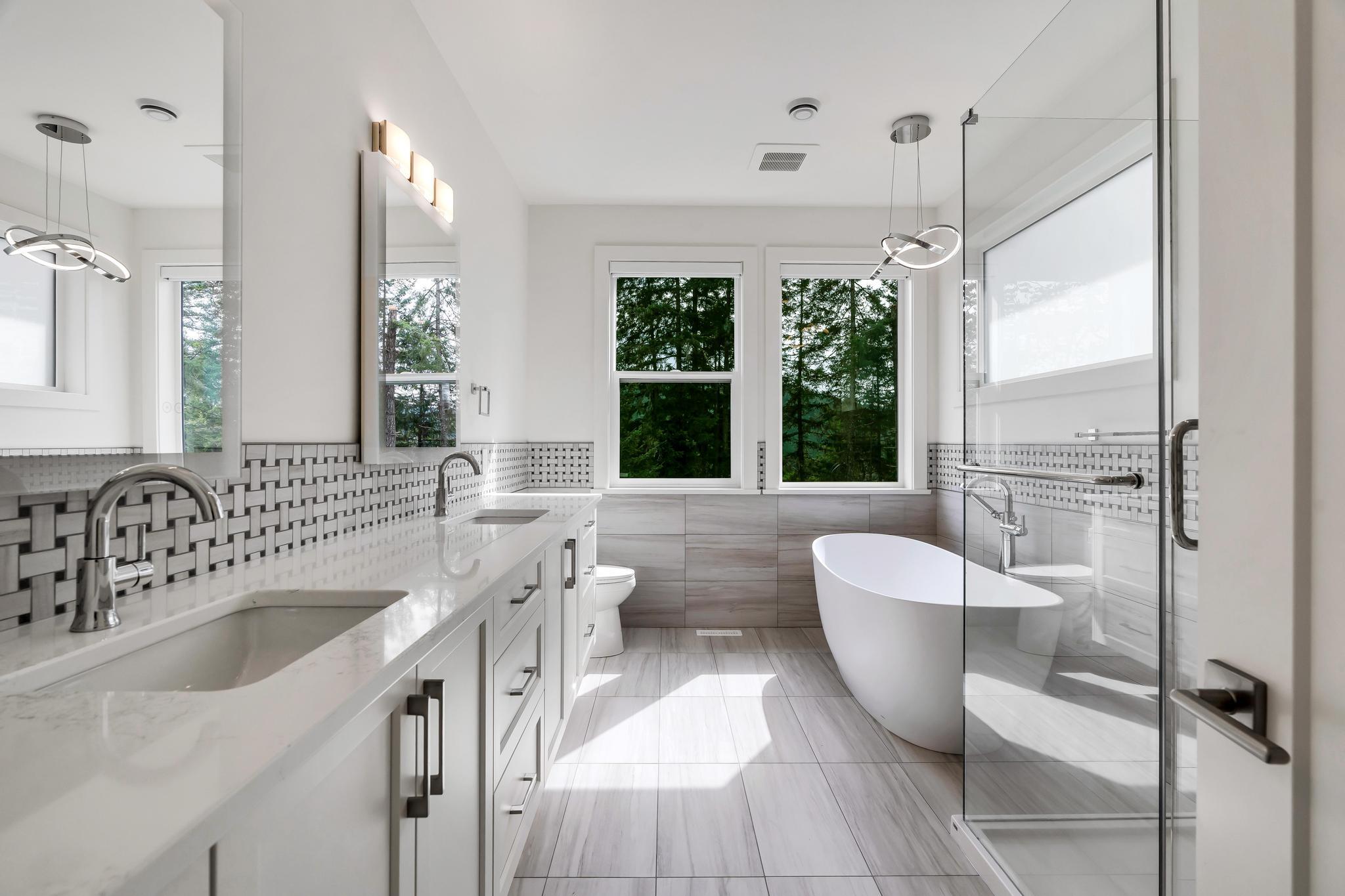
- 60 inch vanity: The minimum width we recommend for a true double sink setup. Each sink gets its own usable counter zone.
- 72 inch and up: Luxury primary bathrooms. Often paired with a makeup station between the two sinks.
Beyond width, three more measurements matter:
Depth. Standard vanities are 21 inches deep. Slim vanities at 16 to 18 inches save space in tight powder rooms but sacrifice drawer storage and counter room.
Height. The old standard was 32 inches, sized for kids. Comfort height vanities at 34 to 36 inches are now the norm for adult bathrooms and match kitchen counter height. If you are taller than 5’10”, strongly consider 36 inch height.
Clearance. BC building code requires a minimum 30 inch centerline-to-wall on either side of the sink, and 21 inches of clear floor space in front. Homeowners squeeze in oversized vanities all the time and regret it later, especially with a swinging door.
Browse our 24 inch vanity, 36 inch vanity, 48 inch vanity, and 60 inch vanity options to see real configurations at each size.
Materials Matter More on the Coast
Vancouver Island’s coastal climate is harder on bathroom cabinetry than most clients realize. Steamy showers, year-round humidity, and salt air all conspire against materials that were not built for it. A vanity that lasts thirty years in dry Calgary may show damage in five years here.
What we build, and what we recommend you look for:
Box construction. The carcass of the vanity (the part you do not see) carries the structural load. Quality vanities use plywood, ideally Baltic birch. Particleboard and low-grade MDF swell when they meet bathroom humidity, and the damage is usually irreversible. Our birch plywood construction is built for exactly these conditions.
Door and drawer fronts. Solid wood, plywood, or thermofoil over MDF. Painted MDF is fine for door fronts as long as the substrate is sealed properly on all six edges, including the back. Cheap thermofoil delaminates in a humid bathroom within a few years.
Countertops. Quartz is the workhorse for Victoria bathrooms because it is non-porous, stain-resistant, and needs zero sealing. Natural stone (granite, marble) looks gorgeous but needs annual sealing and stains from cosmetics. Solid surface materials like Corian are durable and seamless but show scratches. Wood and concrete are statement pieces that demand careful maintenance.
Finishes. Catalyzed conversion varnish or two-part polyurethane finishes hold up to humidity far better than standard lacquer. Ask your supplier specifically what finish system they use. Our cabinet finishes and the guide walks through the options in more detail.
Stock, Semi-Custom, or Fully Custom?
Three buying paths exist, and they are not all created equal.
Stock vanities are mass-produced in a handful of sizes (24, 30, 36, 48, 60), shipped flat-packed or pre-assembled, and bought off the floor at big box stores or online. Prices run $300 to $1,500. They work for rental units, secondary bathrooms, or any project where the bathroom dimensions are forgiving and the design priorities are speed and budget.
Semi-custom vanities are catalog products from cabinet manufacturers, configured to your preferences within fixed parameters. You pick from preset sizes, finishes, and door styles. Lead times run six to twelve weeks. Pricing typically lands between $1,500 and $4,000.
Fully custom vanities are built to your exact specifications. Any width to the nearest 1/16 of an inch, any door style, any finish, integrated features (lighting, hampers, hairdryer drawers, charging stations), and a finish system suited to your bathroom. Lead times run eight to sixteen weeks. Pricing starts around $4,000 for a simple unit and runs to $15,000 or more for large primary bathroom builds with stone tops.
Custom makes the most sense when:
- Your bathroom has an unusual or awkward dimension (very common in older Victoria homes built before standardized framing).
- You want the vanity to match or coordinate with your kitchen cabinetry.
- The bathroom is a primary feature of a high-end renovation and you want a piece that will not appear in your neighbor’s house.
- Storage demands are specific (medication, mobility aids, kids’ items at child height).
Our cabinetry process and custom cabinets cost guides walk through what to expect when going custom.
Style: Matching the Vanity to Your Home
A vanity that fights the rest of your bathroom (or your home) ages badly. The four style families we see most often on Vancouver Island:
Modern and contemporary. Flat slab doors, integrated handles or finger pulls, horizontal grain on wood veneers, floating mounts. Pairs well with newer builds, condos, and minimalist primary bathrooms.
Transitional. Shaker-style doors (the most requested style we build), mixed materials, balanced proportions. The safest stylistic choice if you are planning to sell within a decade, since it suits the widest range of buyers.
Traditional. Raised panel doors, decorative legs, beaded inset construction, often paired with marble or stone tops. Common in heritage homes around James Bay, Oak Bay, and Rockland.
West Coast coastal. Light wood tones (white oak, rift-cut maple, hemlock), white or muted palettes, natural textures, sometimes a hint of blue or sage. Suits homes from Cordova Bay to Sooke that lean into the Vancouver Island setting.
You can browse finished bathrooms in our bathroom portfolio to see how each style reads in a real space.
Storage Features That Actually Earn Their Keep
A vanity is only as useful as the storage inside it. After hundreds of installations, here is what we tell clients to prioritize:
Drawer banks over doors. Drawers give you visible, accessible storage. Doors with a single internal shelf create a black hole where things get lost. A 30 inch vanity with three drawers stores more usable items than the same vanity with two doors.
Soft-close hardware. Worth every dollar. Slams are how drawers fail, doors crack, and finish chips.
Toe-kick drawers. That dead space under the cabinet becomes flat storage for hair tools, scales, or kids’ step stools. Easy upgrade, big payoff.
Tilt-out trays at the sink. The fake drawer panel in front of the sink can flip down into a tray for toothbrushes, toothpaste, and small items. Hardware stores call it a tip-out tray. We can build them into any custom vanity.
In-drawer outlets. The 2018 Canadian Electrical Code allows outlets inside drawers if they meet specific requirements. We can build outlet-equipped grooming drawers so you charge a toothbrush or stash a hairdryer without cluttering the counter.
Integrated hampers. A pullout hamper inside a tall bathroom cabinet keeps laundry off the floor and out of sight. Most useful in primary ensuite bathrooms.
Explore more options in our high-end cabinet accessories and cabinet accessories for custom cabinets collections.
Budgeting Your Vanity: What Things Cost in Victoria
Honest numbers, based on what Victoria-area homeowners actually pay in 2026:
- Stock vanity (cabinet only, no counter or sink): $300 to $1,500
- Stock vanity with counter and sink installed: $1,000 to $2,500
- Semi-custom vanity, counter, sink, and install: $3,500 to $7,000
- Fully custom vanity, premium counter, fixtures, and install: $6,000 to $15,000 or more
What drives the spread:
- Size. A 60 inch vanity costs roughly 1.8x a 36 inch in the same line, not 2x, because you do not double the labor.
- Countertop material. Stock laminate adds $200. Mid-range quartz adds $1,200 to $2,500 for a typical vanity. Premium stone can run $3,000 or more for the same footprint.
- Faucets and sinks. A pair of mid-range faucets and undermount sinks adds $800 to $1,500. Premium fixtures alone can run $1,500 or more.
- Hardware. Pulls and knobs run $10 to $80 each. A 60 inch vanity with mid-range pulls is a $200 to $400 line item.
- Plumbing. If your existing rough-in is in the wrong place for the new vanity, you will pay $500 to $2,000 to relocate it.
For more detail on what custom cabinetry costs locally, see our custom cabinets cost in Victoria BC guide.
Plumbing Considerations Most Guides Skip
Your bathroom’s existing plumbing will quietly veto half your vanity options if you let it. The big ones to check before you fall in love with anything:
Rough-in location. Where does the water supply enter and the drain exit the wall? Stock vanities assume one of two standard layouts. A wall-hung or floating vanity moves the drain elevation. Vessel sinks raise the basin and may require different supply heights.
Floating vanities need wall reinforcement. That clean modern look sitting off the floor is held up by ledger boards or steel brackets fastened into wall blocking. If your wall does not have blocking already, your contractor will need to open the wall, add 2×10 blocking, and reseal. Plan for it.
Drawer fronts versus traps. A vanity with a top drawer at the sink often has to be notched around the P-trap, which limits the drawer’s depth. False-front drawers with tilt-out trays solve this. Clients who do not know about the conflict often end up with a drawer they cannot fully open.
Vessel sinks. Beautiful, but they raise the rim of the basin four to six inches above the counter. That means dropping the vanity to 30 to 32 inches tall, or it ends up too high for comfortable use.
Frequently Asked Questions
What is a comfortable bathroom vanity height?
For most adults, 34 to 36 inches feels right. The old 32 inch kid height still appears in older Victoria homes but is too low for daily adult use. Vessel sinks lower the recommended cabinet height to 30 to 32 inches.
Should I get a single or double vanity?
The break-point is 60 inches of wall space. Below 60 inches, a single vanity gives each user more usable counter. At 60 inches and up, a double makes morning routines smoother in a shared bathroom. Anything under 54 inches is too tight for two functional sinks.
How long do custom bathroom vanities take to build in Victoria?
Lead times run eight to sixteen weeks from design sign-off, depending on finish, hardware availability, and counter material. Stone counters add two to three weeks for templating and fabrication after the vanity is installed.
Are floating vanities a good idea in a small bathroom?
Yes, often. The exposed floor underneath makes the room feel larger and is easier to clean. The trade-off is reduced internal storage (you lose toe-kick drawer space) and wall blocking that has to be planned during framing or drywall.
Can a bathroom vanity match my kitchen cabinets?
Yes, if both are built from the same shop with the same finish system. Painted finishes are easier to match exactly than stained wood, because wood grain varies even within the same species. If you want kitchen-to-bathroom consistency, plan both at the same time so the colors come from the same paint batch.
Do I need a permit to replace a vanity in Victoria BC?
A like-for-like vanity replacement usually does not require a permit. Moving plumbing, changing the layout, or adding electrical does. The City of Victoria’s permit office can confirm. Rules in Saanich, Oak Bay, and other CRD municipalities vary slightly.
Ready to Plan Your Bathroom Vanity?
A bathroom vanity is a fifteen-year decision in a high-moisture environment. The cheap option saves money on day one and rarely on day three thousand. The right vanity, built with the right materials, sized for the room, and installed with the right plumbing prep, is what gets you a bathroom that still looks current the day you sell.
Harbour City Kitchens designs and builds custom cabinetry for homes across Vancouver Island, with projects in Victoria, Sidney, Saanichton, Langford, Nanaimo, and beyond. If you are planning a bathroom renovation or just replacing a tired vanity, book a consultation and we will help you map out the right path for your space.