Beyond the Kitchen: Custom Built-Ins, Home Office, and Storage Cabinetry
The same shop that builds a kitchen can build almost anything else in a house, and most homeowners never think to ask. Custom cabinetry outside the kitchen is one of the highest-value uses of millwork there is, because the spaces that need it most are usually the ones a big-box modular system fits worst: the awkward alcove, the sloped ceiling, the wall that is three inches off standard.
Here is where built-ins genuinely pay off, what to specify so they perform, and how to make new work match cabinetry you already have.
Where built-ins earn their money
Home offices. The most common request since 2020 and the one where modular furniture fails hardest. A built-in desk can be set to the right height for you, run the exact width of the wall, and hide cable management entirely. It also survives being used eight hours a day, which most flat-pack desks do not.
Media walls and fireplace surrounds. Framing a television and integrating storage turns an awkward focal wall into a designed one. Ventilation planning for AV equipment matters here and is easy to get wrong.
Mudrooms and entries. On Vancouver Island this is a genuinely functional room, not a nicety. Wet coats, boots, dog gear. Benches with lift-up storage, hooks at two heights, and cubbies sized to what you actually own.
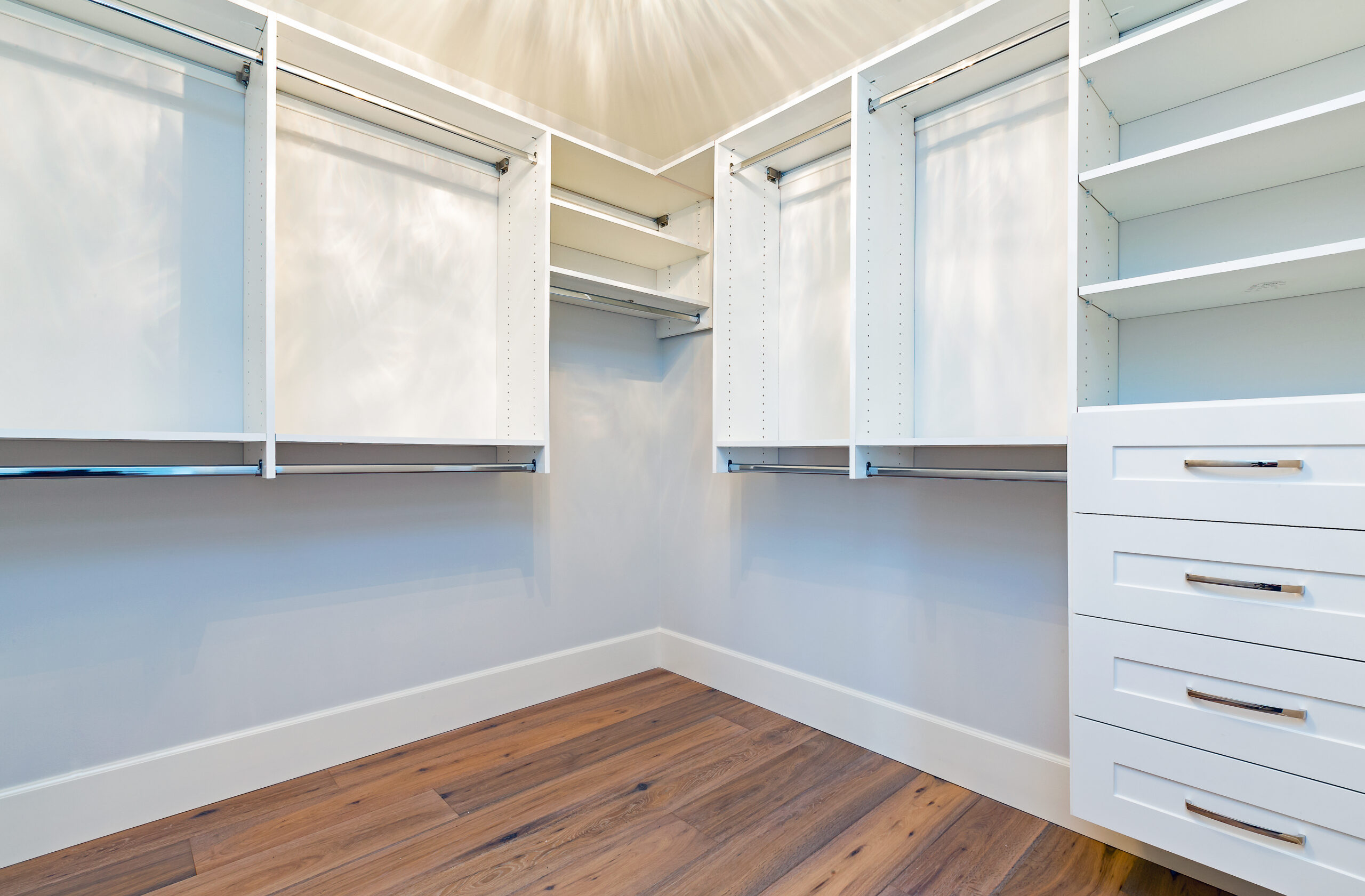
Closets and dressing areas. A custom walk-in gets far more capacity out of the same square footage than a wire system, because the shelf heights, hang rod placement, and drawer sizes are set to your clothes. See our closets work for examples.
Under-stair and eave storage. These are the spaces nothing standard fits. Custom is not a luxury here, it is the only option that uses the volume.
Laundry rooms. Counter over the machines, a hanging rod, a pull-out hamper, and a place for supplies converts the worst room in most houses into a working one.
Shelf spans: the specification nobody asks about
The most common failure in built-in shelving is sag, and it is entirely predictable. A shelf deflects based on its material, its thickness, its depth, and how far it spans unsupported.
The rough rules that matter:
- Books are heavy. A packed shelf of hardcovers is a serious distributed load and is the benchmark you should design to, even if you plan to display objects.
- Three-quarter inch plywood handles a considerably longer unsupported span than particleboard or MDF of the same thickness, because of the cross-grain structure.
- MDF is the worst performer for long spans and will sag visibly under book load, though it is excellent for painted doors and short shelves.
- Deeper shelves sag more than shallow ones at the same span.
- A front edge band, whether solid wood or a thicker applied edge, dramatically stiffens a shelf. It acts like a beam.
- Adding a centre support or a vertical divider solves the problem completely and is almost always cheaper than upgrading the material across a whole wall.
Tell your maker what is going on the shelves. A wall built for framed photos and a wall built for a library are not the same wall, and it costs far less to specify correctly than to fix a sagging run three years later.
Home office specifics
Desk depth. Standard kitchen base depth is generous for a desk. A shallower depth often works better in a home office, leaving the room feeling open while still fitting a monitor at a comfortable viewing distance. If you use two monitors or an ultrawide, go deeper.
Desk height. Standard counter height is too tall for most people to type at comfortably. Desk height is typically lower. This is one of the clearest advantages of custom: it gets set to you.
Cable management. Plan it during design, not after. A grommet in the surface, a channel or tray under the desk, and a dedicated compartment for a power bar and modem keeps the whole thing clean. Add outlets inside the cabinetry.
Ventilation. Any enclosed compartment holding a computer, router, or AV gear needs airflow. A closed box with a hot device in it is a shortened lifespan for that device.
Video call background. A practical consideration now. Built-in shelving behind a desk is the most flattering backdrop most home offices can have, and the lighting for it should be planned in.
Matching built-ins to existing cabinetry
This is where custom work either looks intentional or looks added on.
If you want a seamless match to an existing kitchen, bring a door to the shop. Photographs will not do it. Colour, sheen level, and grain all need to be assessed in person, and sheen is the one people forget: the same colour in satin and in matte read as two different finishes side by side.
Be aware that an exact match to cabinetry more than a few years old is often not achievable, because the existing finish has aged. Wood species amber, paints shift slightly, and the new work will look newer. There are two honest ways forward. Either accept a close match in a room that is visually separate from the kitchen, or design the built-in as a deliberate contrast, which frequently looks better anyway. A different colour in the same door style and hardware reads as designed rather than as a failed match.
Our cabinetry page covers the door styles and finishes available, and the gallery shows completed work beyond kitchens.
What drives the cost
Built-ins are priced on much the same basis as kitchen cabinetry: linear footage, material and finish, complexity of the joinery, number of doors and drawers, and site conditions. Two things push cost up more than people expect. Scribing to out-of-square walls, which is standard in older Victoria homes and takes real time on site. And integrated features such as lighting, appliance or equipment openings, and specialty hardware.
Two things keep it down. Open shelving costs less than doors and drawers. And a design that works in standard cabinet increments where it can, using custom only where the space demands it, delivers most of the benefit for less.
See our overview of custom cabinet costs in Victoria BC for how quoting works.
The bottom line
The strongest case for custom cabinetry outside the kitchen is fit. Built-ins use volume that nothing off the shelf can reach, they are built at the dimensions you actually need, and they are made from the same materials and hardware as a kitchen, which means they last accordingly. Get the shelf spans specified properly and plan the cable management before the drawings are final, and the rest is straightforward.
Talk to Harbour City Kitchens
Harbour City Kitchens has designed and built custom cabinetry in Victoria for more than 45 years. Everything we make is built locally by our own team, for homes across Greater Victoria and Vancouver Island. Visit our showroom to see doors, finishes, and hardware in person, or book a consultation to talk through your project. You can also get in touch here.
Frequently Asked Questions
What material should I use for built-in bookshelves?
Three-quarter inch plywood is the practical default because its cross-grain structure resists sag far better than particleboard or MDF at the same thickness. A solid wood or thicker applied front edge stiffens the shelf substantially. For long runs, a centre support or vertical divider is cheaper than upgrading the material across the whole wall.
How deep should a built-in home office desk be?
Shallower than a standard kitchen base cabinet works well for most single-monitor setups and keeps the room feeling open. Go deeper if you run dual monitors or an ultrawide. Height should be set lower than counter height for comfortable typing, and getting that right for you is one of the main advantages of custom.
Can new built-ins match my existing kitchen cabinets?
A close match is often possible, but an exact match to cabinetry more than a few years old usually is not, because the existing finish has aged. Bring an actual door to the shop rather than a photo. If the built-in is in a separate room, a deliberate contrast in the same door style and hardware often looks better than a near-miss match.
Are custom built-ins worth it compared to modular furniture?
In spaces that are awkward, out of square, or non-standard in size, custom is often the only option that uses the full volume. It is also built from cabinet-grade materials and hardware rather than flat-pack components, so it holds up to daily use in a way most modular furniture does not.